Search engine optimization is constantly changing. What worked five or ten years ago doesn’t guarantee results today. As search engines get smarter and user behavior shifts, SEO has evolved from a mainly manual task to one that increasingly relies on artificial intelligence.
This change raises an important question for businesses, marketers, and website owners: Should you stick with traditional SEO, or is AI SEO a better option?
The answer isn’t just a choice between one or the other.
In this article, we’ll explore AI SEO and traditional SEO, explain how each method operates, compare their strengths and weaknesses, and help you decide which strategy suits your business best.
If you’re new to AI-driven optimization, you might want to start with our guide: What Is AI SEO? Complete Guide for Beginners, which explains the basics in simple terms.
What Is Traditional SEO?
Traditional SEO is the method most people know. It depends on human-led research, decision-making, and ongoing improvement using best practices.
At its core, traditional SEO focuses on three main areas:
- Keyword research using tools like Google Keyword Planner, Ahrefs, or SEMrush
- On-page optimization, which includes title tags, meta descriptions, headings, internal links, and content structure
- Off-page SEO, such as link building, citations, and brand mentions
In traditional SEO, professionals manually analyze search intent, check competitor websites, write or edit content, and track rankings over time. Changes are made based on experience, data, and intuition.
This approach has worked well for years and continues to do so. However, as websites grow and competition increases, traditional SEO can become slow and hard to manage.
What Is AI SEO?
AI SEO uses artificial intelligence, machine learning, and data analysis to automate and improve SEO processes.

Instead of relying purely on manual research and human interpretation, AI SEO tools analyze vast amounts of data to find patterns, predict trends, and suggest optimizations. These tools can assist with:
- Keyword discovery and grouping
- Analyzing search intent
- Providing content optimization suggestions
- Offering insights on technical SEO
- Forecasting performance
It’s important to know that AI SEO does not replace human expertise. Rather, it serves as a strong assistant that speeds up decision-making and enhances accuracy.
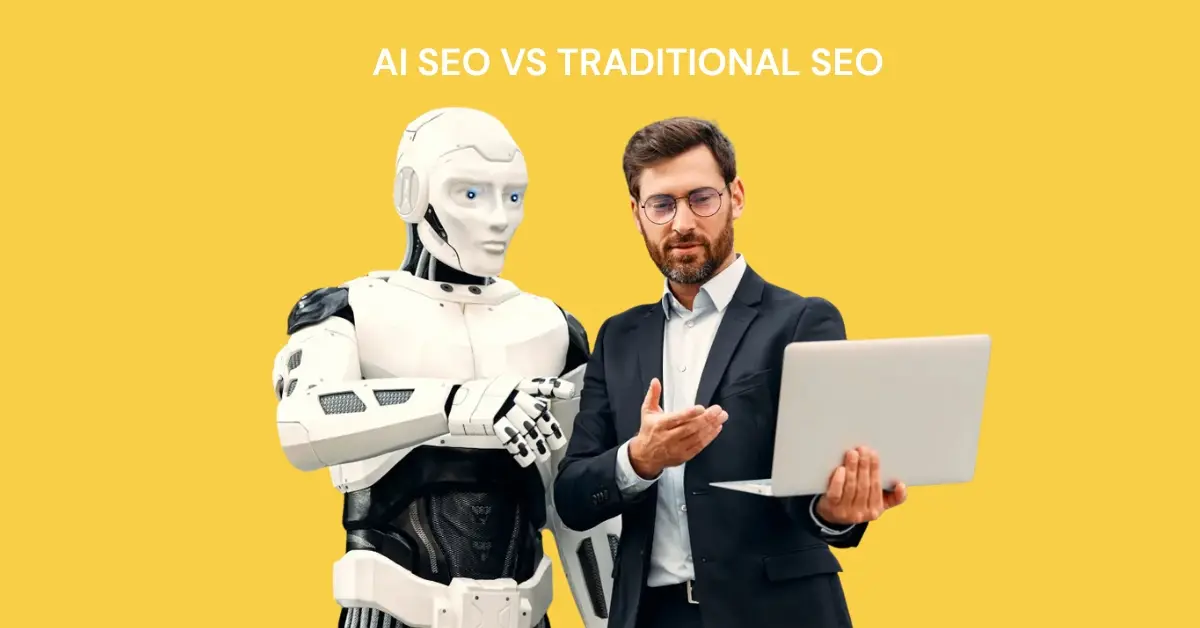
AI SEO vs Traditional SEO: Key Differences
While both methods aim to increase search visibility, they work in very different ways. Let’s explore the main areas where AI SEO and traditional SEO differ.
1. Keyword Research and Search Intent
Traditional SEO:
Keyword research is mainly manual. SEO professionals assess keyword volume, competition, and relevance, then group keywords based on their experience and assumptions about intent. This process is effective but can be slow, especially for larger websites.
AI SEO:
AI tools can process thousands of keywords at once, group them by intent automatically, and spot hidden opportunities. AI can also pick up shifts in user behavior quicker than manual analysis.
Key difference: AI SEO is faster and more data-driven, while traditional SEO relies more on human judgment.
2. Content Creation and Optimization
Traditional SEO:
Content is created by people, optimized using SEO best practices, and refined over time based on how it performs. This method excels in storytelling, brand voice, and emotional connections.
AI SEO:
AI helps with content optimization by analyzing top-ranking pages, suggesting headings, identifying missing topics, and improving semantic relevance. Some AI tools can even create drafts or outlines.
Key difference: Traditional SEO emphasizes craftsmanship, while AI SEO boosts efficiency and accuracy in optimization.
3. Data Analysis and Reporting

Traditional SEO:
Reports are usually made manually, gathering data from various tools. Insights often depend on the SEO professional’s ability to interpret the data.
AI SEO:
AI can analyze real-time data, detect trends, and flag issues automatically. Some platforms can even predict ranking changes or traffic shifts before they happen.
Key difference: AI SEO delivers faster insights, while traditional SEO offers deeper human analysis.
4. Scalability
Traditional SEO:
Managing SEO for a small website is feasible, but scaling to hundreds or thousands of pages becomes difficult and time-consuming.
AI SEO:
AI excels at scaling. It can optimize large websites, automate audits, and manage content recommendations across numerous pages effectively.
Key difference: AI SEO scales easily; traditional SEO needs more human resources as complexity grows.
Traditional SEO vs AI SEO – Quick Comparison
| Feature | Traditional SEO | AI SEO |
| Brand Voice Control | Strong human control | Requires guidance to maintain tone |
| Creativity & Originality | High creativity and storytelling | Can feel generic without input |
| Keyword Research Speed | Manual and time-consuming | Fast and automated |
| Data Handling | Limited with large datasets | Excellent with big data |
| Scalability | Harder to scale | Easily scalable |
| Response to Algorithm Changes | Slower | Faster, data-driven |
| Risk of Generic Content | Low | Medium without human oversight |
Advantages: Traditional SEO vs AI SEO
| Area | Traditional SEO | AI SEO |
| Content Quality | Original, human-focused | Optimized using data insights |
| Audience Understanding | Deep psychological insight | Pattern-based analysis |
| Efficiency | Slower but precise | High speed and automation |
| Cost Over Time | Higher due to manual work | Lower with automation |
| Best Use Case | Branding & storytelling | Large-scale optimization |
Disadvantages: Traditional SEO vs AI SEO
| Area | Traditional SEO | AI SEO |
| Time Requirement | High manual effort | Lower but needs supervision |
| Scalability Issues | Difficult for large sites | Minimal |
| Risk Factors | Slower adaptation | Over-optimization risk |
| Content Consistency | Strong | Can vary without guidance |
| Human Involvement Needed | High | Still required |
Which Is Better: AI SEO or Traditional SEO?
The truth is: neither is superior by itself.

The most effective SEO strategies today combine both approaches. AI takes care of repetitive, data-heavy tasks while humans focus on creativity, strategy, and user experience.
For instance:
- AI identifies keyword opportunities and content gaps
- Humans create engaging, trustworthy content
- AI tracks performance and trends
- Humans make strategic decisions and adjustments
This balance offers both efficiency and quality.
Who Should Use AI SEO vs Traditional SEO?
Small Businesses and Local Services: Traditional SEO with some AI support usually suffices. Human insight into the local audience is crucial.
Content-Heavy Websites and Blogs: AI SEO can greatly speed up research, content planning, and optimization while maintaining quality through human editing.
eCommerce and Enterprise Websites: AI SEO is essential due to the scale, the need for frequent updates, and large product catalogs.
Agencies and Marketing Teams: AI SEO enhances efficiency, allowing teams to produce better results in less time.
The Future of SEO: AI and Human Expertise Together

Search engines are powered by AI, which means SEO strategies must grow along with the technology. However, search engines still favor content that shows experience, expertise, authority, and trust.
AI can spot patterns, but it cannot replace:
- Real-world experience
- Authentic insights
- Brand personality
- Ethical decision-making
The future of SEO belongs to those who use AI wisely while keeping humans at the heart of strategy.
Final Thoughts: Choosing the Right SEO Approach
AI SEO vs traditional SEO is not a competition—it’s a partnership. Traditional SEO lays the groundwork of quality and trust, while AI SEO boosts speed, scalability, and precision.
If you’re just starting, mastering the basics is vital. From there, AI becomes a powerful tool to refine and future-proof your strategy.
To build a strong foundation, we recommend starting with our guide: What Is AI SEO? Complete Guide for Beginners.
It will help you learn how to use AI responsibly and effectively without sacrificing the human touch that great SEO still needs.