If you’re working in SEO or content creation, you’re likely feeling the shock. One day, we’re carefully crafting every sentence. The next, AI can produce a 2,000-word article in seconds. It’s exciting and scary. And it’s changing everything.
But one thing remains the same: trust is still the most valuable asset.
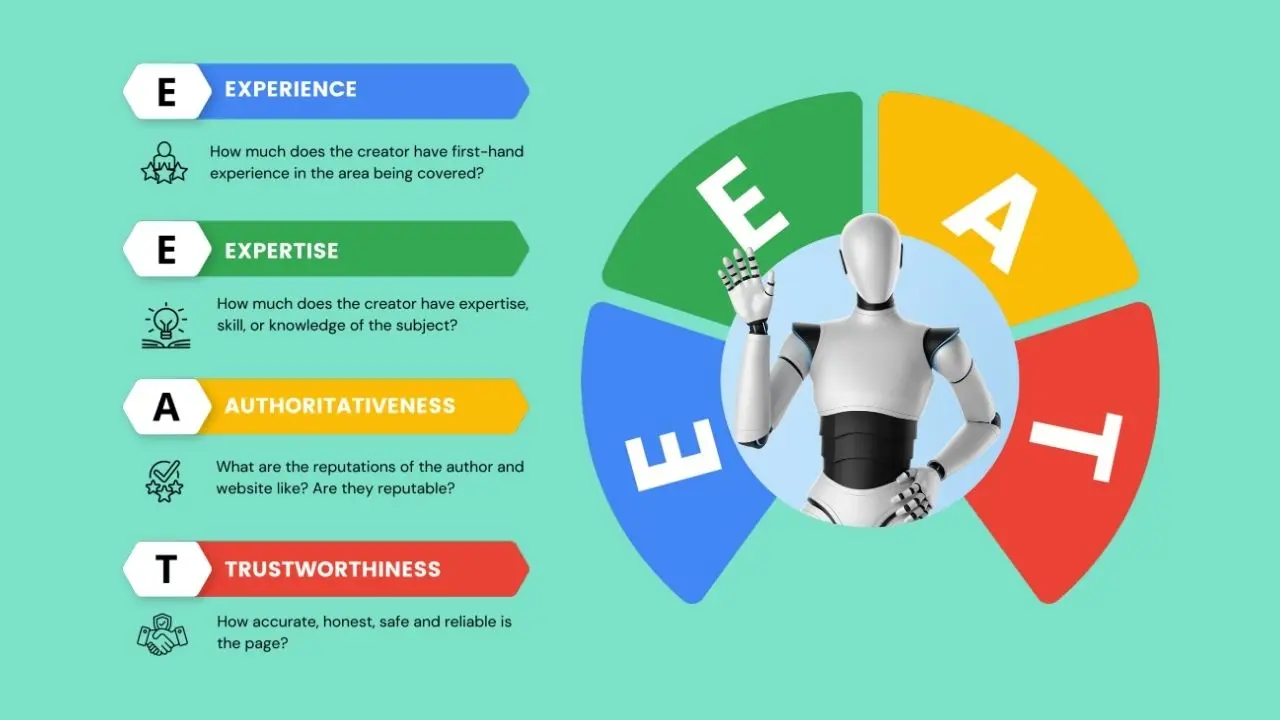
Google understands this. That’s why, in this era of automated content, E-E-A-T (Experience, Expertise, Authoritativeness, Trustworthiness) isn’t just another acronym; it’s essential for survival. It’s what distinguishes the websites that will succeed from those that will be overwhelmed by a flood of AI-generated content.
The Shift: Why Keyword Optimization Alone Is Officially Dead
Remember when SEO felt like a secret code? You could stuff the right keywords and build enough links to rank. Those days are over.
Modern search, powered by AI like Google’s Gemini, doesn’t just look for words; it seeks understanding. It evaluates user intent, content quality, and importantly, credibility. The algorithm doesn’t just ask, “Does this contain the keyword?” It asks, “Can someone really trust this answer?”
This means that producing large amounts of AI content without a plan for E-E-A-T is not only ineffective; it poses a direct risk to your site’s health.
This shift from traditional keyword-focused SEO to a more nuanced, AI-influenced approach defines modern AI SEO. For a deep dive into the mechanisms and key strategies, refer to our comprehensive resource: What Is AI SEO? Complete Guide for Beginners.
Why Google Scrutinizes AI Content Through an E-E-A-T Lens
Google’s guidelines have always focused on quality. Now, with AI content flooding the web, that focus has turned into a strict enforcement. Why? For every legitimate use of AI, countless sites churn out shallow, unverified, and often wrong content at scale.
Google’s mission is to deliver helpful and trustworthy information. Low-effort AI content stands in direct opposition to that. So, the algorithm now heavily relies on E-E-A-T signals to evaluate content. It seeks evidence that real human expertise and experience stand behind the content.
Experience
This is the “new E” in E-E-A-T for a reason. An AI can summarize how to change a car tire. It cannot describe the feeling of the lug nut finally breaking loose after you’ve stood on the wrench, or the grimy satisfaction of the job done.
How to Inject Experience:
- Use AI for scaffolding, not the soul of the piece. Let it draft a structure, then fill it with your personal anecdotes, case studies from your work, or real customer stories.
- Show, don’t just tell. Instead of “optimizing a website is important,” write about the specific load-time issue you debugged for a client last week and the impact it had.
- Your unique experience is your IP. It’s the one thing an AI cannot replicate. Lead with it.
Expertise
AI is brilliant at assembling known information. It’s not brilliant at original thought, nuanced judgment, or cutting-edge insight. Your expertise bridges that gap.
How to Demonstrate Expertise with AI:
- Use AI as a research assistant, not a ghostwriter. Have it gather sources, then analyze and challenge them with your own knowledge.
- Structure content to reflect deep understanding. Go beyond basic Q&A. Address follow-up questions, explore trade-offs, and discuss methodologies.
- Support claims with precision. Have AI help find data points, but then vet them, explain their significance, and connect them to practical application.
Authoritativeness
When content sounds generic, authority evaporates. Authoritativeness is what makes users—and Google—see you as a leader in your space.
How to Build Authority in an AI World:
- Develop a consistent, recognizable brand voice that AI content is trained to emulate, not define.
- Double down on niche focus. Become the undeniable expert on a specific topic cluster, not a shallow generalist.
- Use AI to scale the supporting elements of authority, like creating outlines for definitive guides, but ensure the final output is unmistakably “you.”
- Continue traditional authority-building: Seek quality backlinks, digital PR, and mentions from reputable industry sources.
Trustworthiness
This is the bedrock. If you lose trust, you lose everything. AI introduces new risks: factual inaccuracies, odd hallucinations, and a sterile tone that can feel untrustworthy.
How to Make AI Content Trustworthy:
- Embrace transparency. Consider disclosures like “This article was drafted with AI assistance and rigorously fact-checked and edited by our team.”
- Implement a non-negotiable human layer: Fact-check every claim. Verify every statistic. Add proper citations.
- Strengthen your site’s trust signals: A clear “About Us” page with real bios, a visible “Contact” page, and transparent privacy/ethics policies are crucial.
Using AI as Your Copilot, Not Your Autopilot
The winning formula is now AI + HI (Human Intelligence).
Where AI excels: Brainstorming, overcoming blank-page syndrome, drafting structures, summarizing complex information, and scaling content production.
Where Humans are essential: Injecting experience, applying expert judgment, ensuring accuracy, refining voice and nuance, and making strategic creative decisions.
Your new workflow should always end with a human in the driver’s seat, asking: “Does this sound like us? Is this truly helpful? Is this trustworthy?”
Common Pitfalls to Avoid
- Publishing unedited AI content. This is the fastest way to sound like everyone else and risk factual errors.
- Ignoring niche specialization. AI makes it easy to write about everything; discipline is required to write authoritatively about your thing.
- Over-optimizing for bots. Stuffing keywords or focusing on length over depth misses the point entirely. Add unique value.
The Future: Human Credibility as the Ultimate Competitive Advantage
As search AI gets smarter, its ability to detect human quality and trustworthiness will only sharpen. The sites that win will be those that use AI as a tool to amplify their unique human perspective, not replace it.
E-E-A-T is no longer just a best practice for YMYL (Your Money Your Life) topics. It’s the core framework for all sustainable SEO in an AI-first world.
In the end, AI hasn’t changed what search engines and users seek. It has simply made it harder to fake. The goal remains to create content that genuinely helps, informs, and earns trust. AI is a powerful new brush, but the vision, the experience, and the authority must come from you. Use the tool, but lead with your humanity. That’s how you build something that both users and algorithms will believe in for the long run.